A methodology built around the people you exist to serve.
Most leadership development starts with the leader. Most strategic planning starts with internal goals. Both produce something that looks right on paper – and often delivers little where it matters most: in the experience of the people an organisation exists to serve.
The AnchorPoint Method starts somewhere different. With a deceptively simple question: who must experience the difference you make for your vision to become reality?
Answer that honestly – and everything else follows.
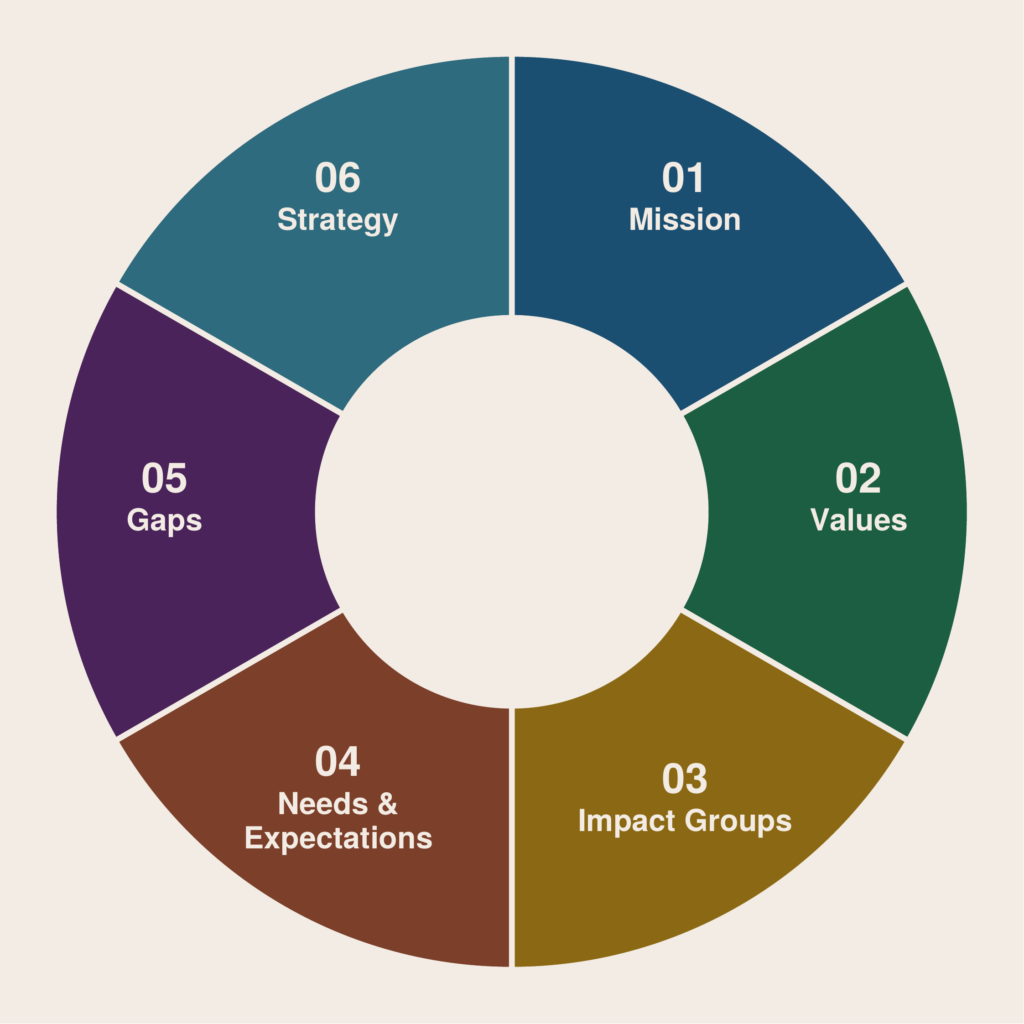
The AnchorPoint Method – Six Steps
Six steps. One direction. Outside in.
01 – Mission
Define what your organisation truly exists to do – and what ‘great’ looks like when you are living it fully. This isn’t about wordsmithing a statement. It’s about the clarity that makes every subsequent decision easier.
02 – Values
Establish the non-negotiable principles that shape how you operate, lead and relate. Values aren’t decorative. In the AnchorPoint Method, they are guardrails that keep strategy grounded in character.
03 – Impact Groups
Map the specific people your organisation exists to serve – customers, teams, community, partners. These are the groups whose experience of you determines whether your mission is actually succeeding.
04 – Needs & Expectations
For each Impact Group, go deeper. What do they absolutely need from you? What do they expect in terms of experience? The distinction matters: needs are the floor; expectations are what builds loyalty and trust.
05 – Gaps
Honestly assess where your current leadership, capability, or strategy falls short of what your Impact Groups need. This is the most uncomfortable step – and the most valuable. You can’t close a gap you haven’t named.
06 – Strategy
Design a focused, practical plan to close those gaps and move from insight to execution. Not a document that sits on a shelf – a living plan that connects your people’s daily work to the mission that started the process.
The Method is the map. The craft is the journey.
The six steps of the AnchorPoint Method give the process its structure. What they can’t show you is what happens inside the room.
The questions that surface what’s really going on beneath the surface. The conversation that create genuine listening between leaders and their teams – and among teammates who have never quite been able to say what they actually think. The intentional facilitation that makes it safe to be honest, even about the things that have been difficult to name.
Anyone can follow a process. What changes the outcome is the quality of thinking, listening and presence that guides people through it.
It’s the difference between knowing the principles of good communication and being able to actually do it – in a room full of people with competing agendas, unspoken tensions, and real stakes.
When you engage AnchorPoint, you’re not buying a six-step framework. You are investing in what happens when someone who has spent years facilitating difficult conversations in high-pressure environments walks alongside your team – creating the spake, asking the questions at the right moment, and helping your people find the clarity and direction they’re capable of.
The method makes the work visible. The craft makes it valuable.
Two Applications
Strategic Clarity
All six steps run as a facilitated process with your leadership team – producing a grounded, stakeholder-connected strategy with shared ownership and a clear path to execution.
Delivered as a workshop series, planning retreat, or ongoing coaching engagement.
Leadership Development
Steps 1-4 define the leadership standard your organisation requires – grounded in who you serve, not a generic competency framework. Steps 5-6 diagnose capability gaps and build a bespoke development pathway that actually sticks.
Delivered through executive coaching, group coaching, or structured leadership programs.
When Organisations Call Us
The AnchorPoint Method is most valuable at specific moments – when something has changed, or when the gap between where an organisation is and where it needs to be has become impossible to ignore. Here are the most common situations we work in.
Case Study #1 The vision is clear. The team hasn’t quite caught up with it yet.
You’ve built something real. The strategy makes sense. The funding is in place. But somewhere between your leadership team and the people doing the work, the direction is getting lost. People aren’t pulling against each other — they’re just not quite pulling together. Nobody names it. The business keeps moving, but not with the alignment it needs to get to the next stage. AnchorPoint works with founders and leadership teams to surface what’s getting in the way — not by adding another framework, but by listening to what’s actually happening and helping leadership close the gap between where the business is and what it’s genuinely capable of.
Case Study #2 The restructure is complete – but alignment hasn’t followed.
Your people are exhausted, priorities are unclear, and the leadership team is carrying more than it should. AnchorPoint works alongside you to rebuild clarity from the ground up: reaffirming what your organisation exists to do, identifying where leadership needs strengthening, and creating the shared direction that turns a leaner structure into a stronger one.
Case Study #3 The strategy has changed – but has the organisation changed with it?
When direction shifts, the work of bringing your people along Is just as important as the new plan itself. AnchorPoint helps leadership team reground in mission, align exceptions at every level, and build the leadership depth and strategy clarity needed to carry the new direction all the way through.
Case Study #4 When new leadership arrives – and needs to listen before it leads.
The new leader who listens first builds trust. The one who acts without understanding the team’s world risks losing it. AnchorPoint works with incoming leaders to surface team thinking, create genuine alignment around mission and direction, and build a shared foundation for what comes next – so the transition becomes a catalyst for clarity rather than a source of uncertainty.
Case Study #5 The compliance report says you’re covered. Your people aren’t so sure.
Your policies exist. Your EAP is in place. The psychosocial risk assessment has been done — or something that looked like one. But turnover is quietly climbing, engagement is flat, and something feels off in ways that are hard to name. AnchorPoint works alongside your HR and safety teams to surface what the documentation misses — the gap between what exists on paper and what your people are actually experiencing — before it becomes something harder to manage.

How an Engagement Begins
The Clarity Session
Every engagement begins with a focused 45 minute conversation. Not a proposal. Not a sales pitch. Free of charge and no obligation. We map where you are, where you want to go, and what’s getting in the way. You leave with clarity – whether we work together beyond that is entirely your decision.